
Dancing Chameleons
The science behind the slow-dance like gait of Chameleons

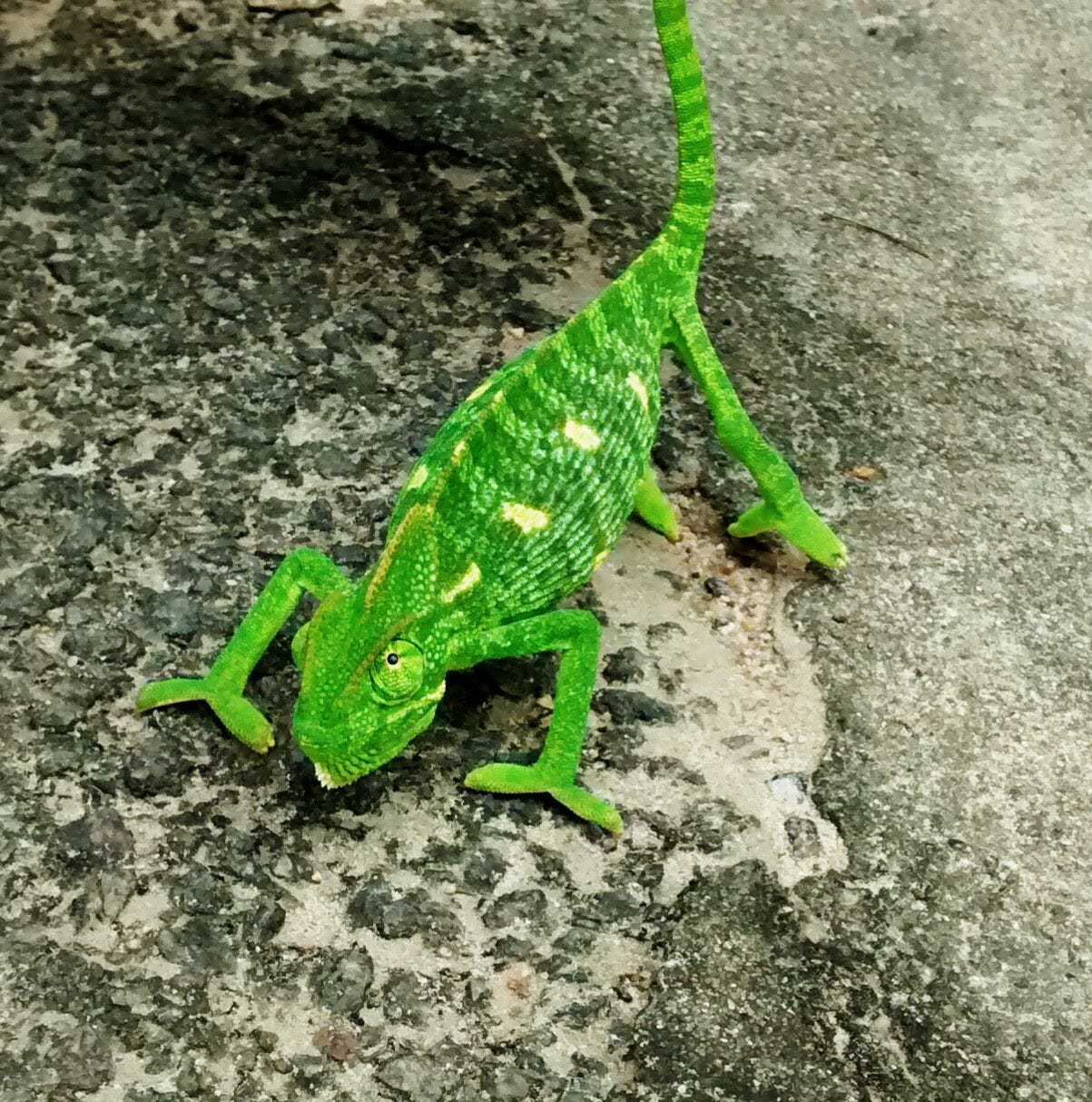
During the time I spent in University of Hyderabad, it was considered a wildlife haven. The university seemed to be built within a natural forest that surrounded the roads and buildings on all sides. While living in the hostel, it was natural to wake up to the calls of peacocks early in the morning. My friends and I loved exploring the natural beauty around us, climbing the natural rock formations, and spotting animals like deer, wild hare, and even porcupine!
It was here, while cycling on the university roads, that I first saw a bright green chameleon trying to cross the road. Unlike the garden lizard that scurries away so quickly that you can hardly get a few seconds to glimpse it, the chameleon was walking very slowly. So slowly, in fact, that I thought it wasn’t even moving when I stopped my cycle beside it. I observed it for a while and noticed it’s strange bob-dance-walk. It was rocking back and forth before taking every slow step. Well, that explained why it seemed so slow in crossing the road!
It looked for all the world like it was dancing to the beat of one of those Michael Jackson songs!
I couldn’t just leave it there in the middle of the road to be run over by a vehicle, as was sure to happen if it kept dancing like that before taking every step! So, I gently picked it up and transported it across the road to the edge of the forest cover.
I kept wondering about its funny way of dance-walking and decided to find out more. What I found was quite interesting.
In the wild, to blend in with their surroundings and escape their predators, chameleons mimic the swaying of leaves in a breeze so that they can pass unnoticed.
With their ability to change colours to match the leaves and branches and their dance-walk, it must be a pretty good disguise while moving on a tree. Alas, it was far from inconspicuous on the road! I must have spotted the bright green dancing critter from about a hundred meters away! Luckily, I have no interest in being its predator!
Other than camouflage, the chameleon has another reason for the slow dance-like gait. Scientists debate that chameleons may not have a perception of depth, and the back-and-forth dance walk helps them to gauge each step without falling. Try closing one eye and walking in a straight line. As soon as we shut one eye, our world suddenly feels 2-dimensional, and walking becomes quite difficult. We have something called stereoscopic vision – our eyes move together to perceive the world 3-dimensionally.
But for the chameleon, each eye moves independently from the other and provides a nearly 360° view. As its eyes swivel around in different directions, rapidly taking in the surroundings from all sides, the chameleon moves slowly with purposeful steps so that it can maintain balance and precision without needing to look where it places the next step.
It helps the chameleon to move over a variety of different surfaces without faltering. Although it looks funny, this gait is so efficient that it has inspired scientists to use it for space robots! Robots in space need to efficiently move over rough terrain. Biomimicking the chameleons’ feet and gait has helped scientists design robots that can walk precisely over different types of terrain, grasp and handle different types of objects. In fact, it is perfect for maneuvering robots in zero gravity conditions!
Who knew that the funny gait of Chameleons was so useful! Nature is amazing and teaches us many new things. We just need to observe, question the things we observe around us, and learn something new each day.